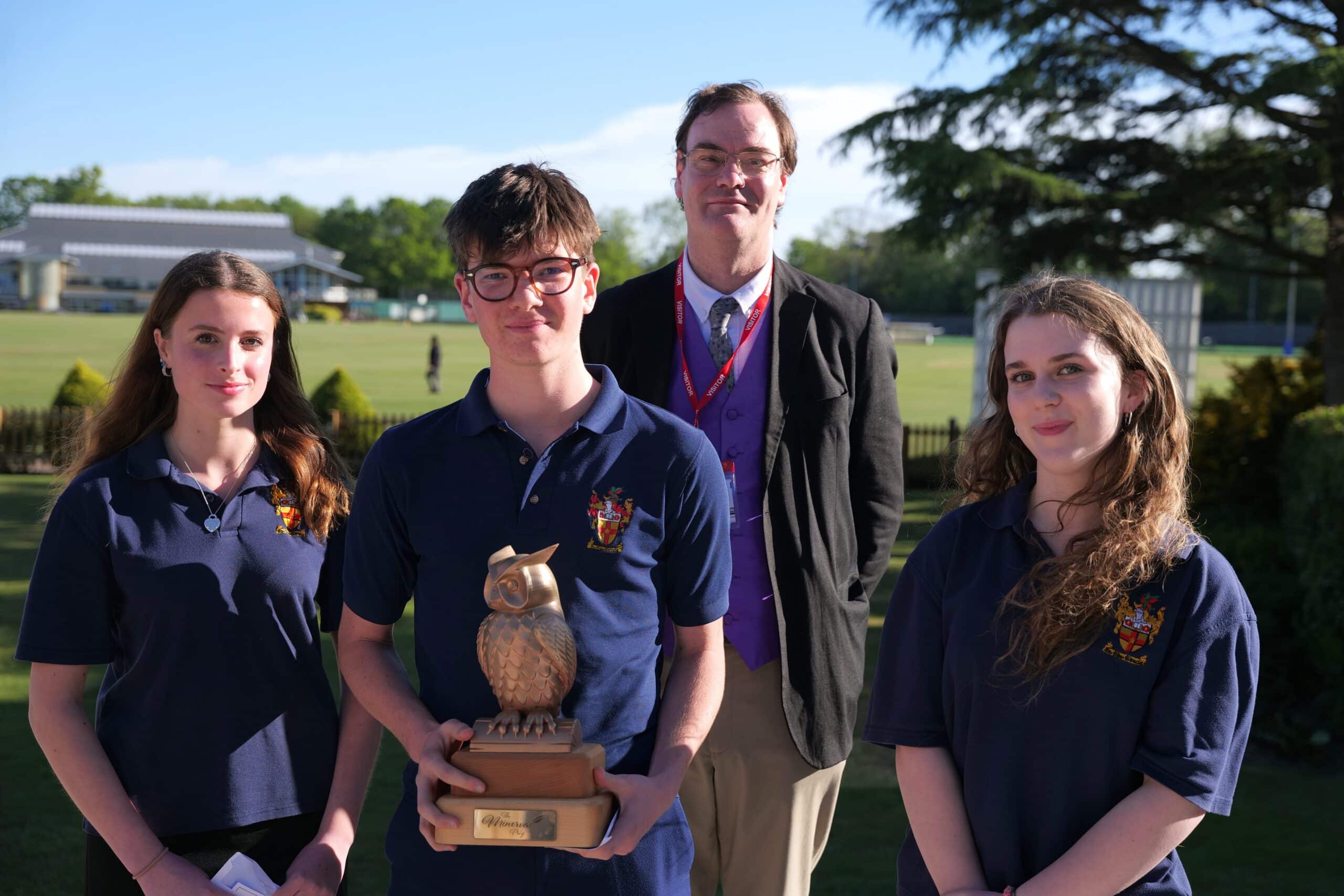
Minerva Prize Winners 2026
In a prizegiving ceremony held on Wednesday 29 April, the third Minerva Prize was awarded to Benji P. Hermione H took second place and Aimie D finished in third. The competition invited pupils to submit essays on a topic of their choosing for consideration by Stephen Hancock, former English teacher at The Leys and the person responsible for setting up the prize in 2023.
In beautiful sunshine on the Head’s Lawn, pupils, staff and parents gathered for the announcement, with this year’s essays displayed on boards around the patio for pupils, staff and guests to enjoy.
Stephen Hancock presented the winner with the Minerva trophy and praised the calibre of entries, noting that: “choosing the winners and runners up was very hard; indeed, the value of these competitions is to be found in the process, and not the result.”
Benji’s winning essay, Counting stars and measuring meaning: Economic abstraction in The Little Prince, offered an original lens on Saint-Exupéry’s much-loved novella. Stephen commended the “originality” of the argument, describing the essay as “well researched, well evidenced and sensitively written”, adding that it ultimately became “a humane and mature piece” which shows how the text still resonates today.
Second place went to Hermione for Erotic autonomy and social transgression: Reassessing female agency in Lawrence’s Lady Chatterley’s Lover. In his feedback, Stephen praised Hermione’s “mature and sensitive” writing and the way the essay “offered a nuanced and detailed study” of the tensions at the heart of Lawrence’s novel, sustained through “extremely fluent” analysis and an impressive command of different critical approaches.
Third place was awarded to Aimie for Jane Eyre: How does romantic idolisation affect religion? Stephen highlighted the “fluency” of Aimie’s writing and described her “elegant phrasing” as “one of the great pleasures” of reading the work, praising the essay’s consistent, detailed and sustained argument.
Named after the Roman goddess of wisdom, and sponsor of the arts, medicine and crafts, the Minerva Prize celebrates ambitious reading and independent thinking, inviting pupils to explore the links between literature and the wider world. Pupils are invited to submit a 2,000-word essay on a title of their choosing, using literature, novels, drama or poetry as the lens through which to examine ideas from across disciplines.
This year’s displayed essays reflected the breadth the prize encourages, tackling questions of politics, philosophy, faith and morality alongside close literary analysis and a wide range of texts and contexts. All entries can be read in the document below.